
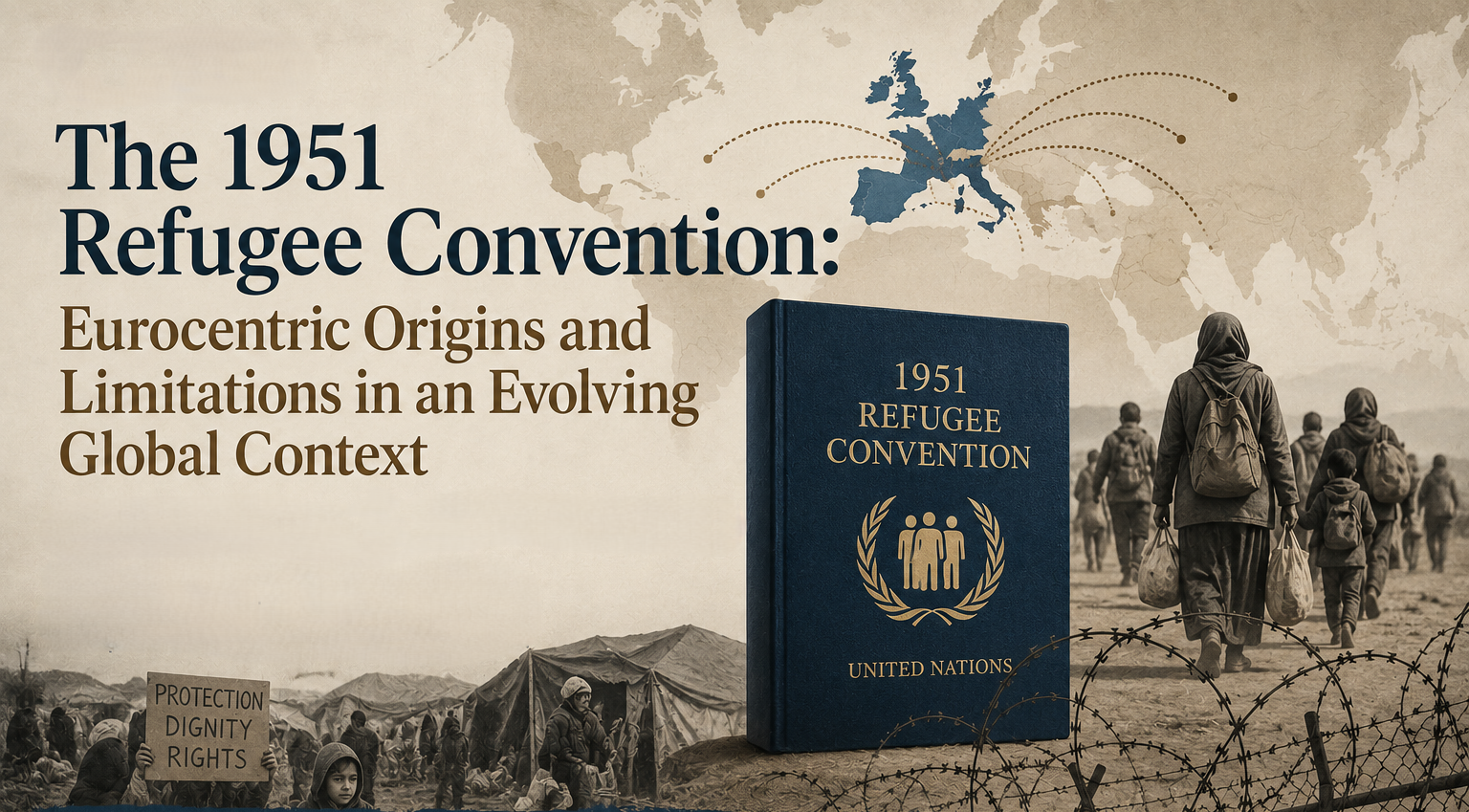
The 1951 Convention Relating to the Status of Refugees governs the current international system for refugee protection. The Convention established a foundational legal framework for international refugee protection. The massive migration of people in Europe after World War II prompted the international community to develop a unified system of law. The Protocol Relating to the Status of Refugees 1967 was later adopted to remove any time and geographical limitations from the 1951 Convention. However, there are several experts who argue that the convention is still Eurocentric in nature and has limited relevance to contemporary global refugee problems. This article aims to critically evaluate the historical background of the convention, Eurocentrism in the convention, and its limitations. According to Article 1(A) (2) of the 1951 Refugee Convention, a refugee is a person who is outside his or her country of nationality owing to a well-founded fear of persecution based on race, religion, nationality, membership of a particular social group, or political opinion. The most important principle of this Convention is the principle of non-refoulement. This principle requires states not to send back refugees to their countries if there is a threat to their life or freedom. It is now accepted as a norm of customary international law. The Convention aims to protect the fundamental rights of refugees, and for this reason, it is regarded as an important legal instrument of international refugee law. Academic analysis of the issue often draws attention to the Eurocentric nature of the 1951 Refugee Convention and how it was originally conceived without a global perspective with respect to refugee crises.
The 1951 Convention was characterized by two major structural constraints:
- Temporal Limitation: As it was originally conceived, the 1951 Convention was qualified by a temporal limitation, which applied only to pre-1951 events.
- Geographical Limitation: Under Article 1B (1), states could limit their obligations to refugees from events occurring in Europe, thereby initially restricting protection mainly to European refugees. According to B. S. Chimni, in his analysis of this convention, it has been stated that this convention was formulated mainly in the context of the political and strategic interests of Western states, which, in turn, were not representative of the refugee crises in the developing world.
Limitations of the Convention in the Contemporary Context:
- The Narrow Definition of Refugee: The refugee definition under the 1951 Convention is often criticized for being too narrow in the contemporary context. The Convention primarily recognizes persecution based on five specific grounds: race, religion, nationality, membership of a particular social group, and political opinion. However, many displaced persons today flee due to civil wars, generalized violence, environmental disasters, and climate-induced displacements, which are not explicitly covered under the Convention framework. As a result, a significant number of forcibly displaced people remain outside formal international refugee protection.
- Burden-Sharing Problem: Another key issue with the international refugee protection system is the lack of responsibility-sharing between states. James C. Hathaway states, “The Refugee Convention places the burden of refugee protection on states, yet there are no provisions for mandatory burden-sharing between them. This has meant that the majority of refugees are being hosted in developing countries, which has put enormous pressure on their economies and societies.”
The Role of the 1967 Protocol in Addressing Structural Limitations:
Fontaine’s analysis suggests that the 1967 Protocol played a significant role in addressing the inherent limitations of the 1951 Convention through the following mechanisms:
- Remedying Structural Limitations: The Protocol was largely used as the key instrument in addressing the obsolescence of the 1951 Convention. By removing the temporal (pre-1951 events) and geographical (Europe only) limitations of the 1951 Convention, it essentially transformed the refugee convention from a temporary instrument created in response to World War II into a permanent and universal convention.
- Universalization of Refugee Definition: By adopting the Protocol, it essentially removed the refugee definition and status from historical and geographical contexts. This was to ensure that persons fleeing persecution in the Global South, particularly in the context of decolonization in Africa and Asia, would be protected under a universal definition of refugee.
- Strengthening Global Norms: By making the Convention universal, the Protocol reinforced the principle of non-refoulement as a global norm, making sure that it was not limited to Europe and that the prohibition against returning refugees was not limited by territorial boundaries.
Despite the continued debate on its historical origins, it is an undisputed fact that the 1951 Convention continues to be regarded as the foundation of international protection of refugees. The Convention remains significant as the first international instrument to establish minimum standards for refugee protection, particularly through the principle of non-refoulement, now recognized as customary international law. Although the 1967 Protocol removed major structural limitations, the Convention still struggles to address contemporary displacement crises and therefore requires further reform.
About the Author:
Ateed Siddique is a Research Officer at the Bangladesh Center for Refugee Law Studies (BCRLS). He is currently an LL.M. candidate at the UNESCO Madanjeet Singh South Asian Institute of Advanced Legal and Human Rights Studies (UMSAILS), in partnership with the Department of Law and Human Rights at the University of Asia Pacific, Bangladesh. He completed his LL.B. (Hons.) from the Bangladesh University of Business and Technology (BUBT). His research interests include international law, refugee law, genocide studies, human rights, and criminal law.